

The daily questions practice helped me find clarity in a time of stress. Here’s how it can work for you.
During one of the most stressful times of my life, I found peace by talking to myself.
It’s not what you think — I didn’t have full conversations with my reflection in the mirror. But I did spend an entire year asking myself the same questions every day and answering them honestly.
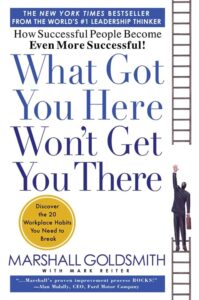 It’s part of the daily question practice developed by Marshall Goldsmith, a top leadership coach and the author of four New York Times best-selling books, including What Got You Here Won’t Get You There: How Successful People Become Even More Successful. I’ve had the pleasure of often working alongside Goldsmith, and his Daily Questions came into my life when I needed it most.
My triplets were teenagers. My career was in full swing, requiring regular travel. I wasn’t taking care of myself and I felt stressed and drained.
The daily questions practice is simple: Jot down a set of key questions that reflect what’s important to you — like your goals and values — and answer them every day. You can answer yes or no, or you can answer on a one-to-10 scale. It also helps to start each question with “Did I do my best to …”
During that particularly stressful time, I settled on a few questions, but one proved most impactful: Did I do my best to nurture myself today?
After a year, I was surprised to find that my stress levels reduced dramatically.
 How did taking a few minutes to ask myself a handful of questions have such a big impact? For one, because I knew the questions were coming, a seed of accountability was planted in the back of my mind. I navigated the day knowing I’d have to reflect on the day’s actions, and that inspired small steps. The sliding scale, and the words “did I do my best,” also allowed for flexibility. It was OK if I didn’t spend the day at a spa — a 10-minute walk, five-minute meditation, or a healthy meal would mean I kept my promise to myself. Perfection isn’t the goal, progress is.
And those small, daily actions added up — I soon started to notice I was sleeping better, was more productive, and felt happier overall. It reminded me of the Chinese saying 滴水穿石” (dī shuǐ chuān shí), which translates to “drip, drip, drip, the water wears through the stone.” With steady, persistent effort, even the smallest actions can have a huge impact.
Goldsmith’s own research with thousands of participants from around the world shows similar results. In one study, participants were asked to answer six engaging questions for 10 days. They reported increased self-awareness and said they were more thoughtful in their actions and more purposeful in how they spend their time.
The daily questions practice is deceptively simple, yet the effect can be profound. Here are some ways to make it work for you:
Choose questions wisely. Reflect on your values, your goals, what inspires you, and what motivates you, and choose questions that direct your focus to those things. Learning motivates me, so one of my daily questions is, “Did I do my best to learn something new today?” Your questions can touch on any area of your life, whether it’s health, work, relationships, personal growth, or all of the above.
Find an accountability partner. The daily questions already inspire accountability — finding someone to check in with daily helps you both stick with the practice. I text my accountability partner her questions, and she replies with her answers. She does the same for me. We also check in with a phone call once a week. A colleague of mine, George, found a partner in an app — it asks him his questions at the same time every day. Consistency is key to the daily questions, and an accountability partner — whether human or digital — can help you stay committed for the long haul.
Suspend judgment. Resist any urge to explain, defend, or rationalize your answers (or your partner’s). If any feelings of shame or guilt come up, address them with a simple “I’ll do better tomorrow.”
Use the data. Find a way to keep track of your answers, whether it’s through a simple journal or an app that can compile your answers into a pie chart or line graph. The data can reveal a lot: Are your numbers going up, down, or staying the same? Are there any patterns, and what do they mean? Long-term, you’ll also have a different kind of data: More clarity on what’s important to you. That invaluable information can help inform your decision-making.
One of my new daily questions is, “Did I do my best to declare victory today?” It’s one of my favorite questions because I get to decide what victory looks like, whether it’s successfully cooking a new recipe, bonding with my kids, or realizing I had a positive impact on someone. When I can say, “I declare victory today!” I’m inspired to get the chance to say those words again the next day.
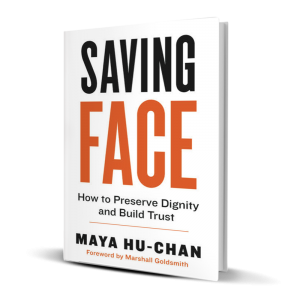 My book, Saving Face: How to Preserve Dignity and Build Trust, illustrates how we can honor face to create positive first impressions, avoid causing others to lose face, and, most importantly, help others save face to build trust and lasting relationships inside and outside the workplace.
This article was originally posted on Inc.com