

By setting clear boundaries, you conserve your energy, guard against burnout, and lead sustainably.
Sometimes, you have to say no to other people to say yes to yourself. Many of my highest-achieving clients—from founders and managers to CEOs—got to where they are by saying yes to opportunity. However, as they climb higher in their careers, they realize they have to be more discerning. As Steve Jobs once said, “Focusing is about saying no.”

For others, saying no becomes a struggle. I see this pattern among my clients who are the most empathetic and in tune with others’ emotions. Ironically, this people-pleasing pattern can lead them to lose empathy for the most important person of all: themselves.
A 2023 study in the Journal of Personality and Social Psychology found that people find it hard to say no even in their social lives. Seventy-seven percent of respondents said they accept social invitations even when they don’t want to attend because they fear the “consequences of declining.” The consequences of never saying no in life and at work can mean exhaustion, resentment, and burnout.
This is the case with one of my clients, who, when I started working with her, was in full burnout mode—exhausted by the demands of her teams. As a high-level executive for a global tech company, she leads teams around the world, which means many of those demands often arrive past her regular working hours. Her team in Singapore, for example, often sends emails asking for a “quick call” at the start of their workday, which is the end of her workday.
I asked my client what happens when she meets these requests with a no. “I tell them, ‘I can’t, I have a family commitment,’ but then they say, ‘Please, it’s really important,’ ” she explained. So, she gives them more reasons why she can’t help: It’s 8 p.m. Her family needs her. She has plans. Her team pushes back again, and my client slowly talks herself into giving up all her reasons. Sure, she can hop on the phone, and that quick call turns into an hour of handholding, with her putting in another 14-hour day.
Her team has become dependent on this pattern: Push a little bit, and she says yes. This means that not only is my client contributing to her own burnout, but she’s also holding her team back from growth, competence, and independence.
If my client knows she’s burned out and exhausted, why does the pattern continue? “If I say no, then I feel like a bad manager,” she said, defining her core mindset. Breaking her out of this pattern started with reframing that mindset. Here’s what we did—and what you can do, if saying no is a struggle for you, too.
Reframe the mindset.
The narrative constantly running in my client’s mind connected the word no with being unhelpful, irresponsible, and unkind. Although she acknowledged the harm this mindset was leading to, she couldn’t shake this fundamental belief. We started by linking the word no to helpful, positive things. The word can be a positive statement that means she doesn’t overcommit. She gets to spend time with family, and she is rested, balanced, and her best self for all her teams. When she says no, it means her teams are empowered, and individuals can grow their skills and independence.
 Rewrite the narrative.
This reframing allowed my client to replace her old narrative with a new one: “I will empower others to take responsibility. I will train others to respect my boundaries.” When you have your new narrative, speak the words out loud, write it down, or do both. This helps cement its place in your mind as a new way of thinking for the next time you must say no.
Refine and redirect for alternative support.
Creating a new mindset is empowering, but what does it mean in practice? My client and I made a game plan that she could follow when those after-work emails arrived. First, she needs to be able to assess the situation. Are these actual emergencies that need her intervention? If not, does the timeline allow for her to help the next working day, or can they work with someone who’s on the clock at that moment?
Then, we set up a process for getting this information. My client would respond via email with the following words: “I am not available at this time. Can you send me an email summarizing the issue? I can get back to you first thing in the morning. If it’s urgent, I can find someone to help you.”
Rehearse the responses.
The team pushback is when my client would usually cave, so we practiced repeating those words: “I am not available at this time. Can you send me an email summarizing the issue?” We practiced until she was comfortable and confident enough to override every “Please!”
While rehearsing, sometimes the old narrative would come back. My client would backtrack, saying that she feared she was being unhelpful. In these moments, it helped to anchor back to her new mindset. Finding someone who has the expertise and bandwidth to assist is, in fact, helpful. You’re helping them build connections across the company. You’re also facilitating their growth, which is helpful to the team and the company.
I also invited my client to state her boundaries kindly, but firmly. When you say no, add a genuine, “I’m sorry.” It helps, and it is not an admission of fault. Instead, it communicates she is sorry the situation is inconvenient, which leans into her natural empathy.
Saying no means saying yes to yourself. By setting clear, respectful boundaries, you conserve your energy, guard against burnout, and lead sustainably, both for yourself and your team.
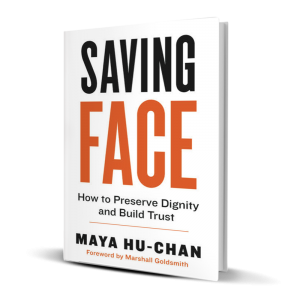 My book, Saving Face: How to Preserve Dignity and Build Trust, illustrates how we can honor face to create positive first impressions, avoid causing others to lose face, and, most importantly, help others save face to build trust and lasting relationships inside and outside the workplace.
This article was originally posted on Inc.com